
Storage and Processing.Keeping seized devices alive.
Faraday cabinets for evidence intake, passcode cracking, and long duration custody.
Built for the weeks, months or years a device needs to be kept alive.
A seized device may have to stay alive for months.
Passcode attacks can take days, weeks and sometimes years, and the device has to remain powered, isolated and accounted for the entire time.
A phone that goes flat mid attack can enter lockout or wipe. A phone that overheats throttles and slows the run. A phone sitting on an unshielded bench can receive a remote wipe instruction. Every one of these scenarios compromises the case, and few of them are recoverable.
The commonly used solution is a power strip and a drawer full of cables. However, cables fail, power bricks overheat and nothing alerts the examiner as to which device died, or when. The device is found dead, and no one can determine how long it has been that way.
The following four forensic cabinets from Mission Darkness were built to address these risks. They are part of the forensic laboratory infrastructure, and they operate alongside whichever forensic software platform your laboratory uses.
Three phases, from intake to examination.
The device journey within a forensic laboratory includes three distinct physical phases, each requiring specific hardware.
Intake and custody
When devices arrive at the station or laboratory, they need to be isolated, powered, individually locked, and accounted for. The Blocker Locker addresses these requirements.
Cracking, with visibility
The Crack Cabinet allows devices and associated paperwork to be stored together whilst under passcode attack. Transparent walls and a master power switch let an examiner read every screen without opening the cabinet.
Volume and monitoring
The Charge Chamber stores up to 40 devices, cooled and monitored remotely, alerting the moment power drops rather than at the next physical check.
Four cabinets, four jobs.
All four offer continuous charging. What differentiates them is capacity, cooling, access control, and how they alert you when something has gone wrong.
Blocker Locker 7
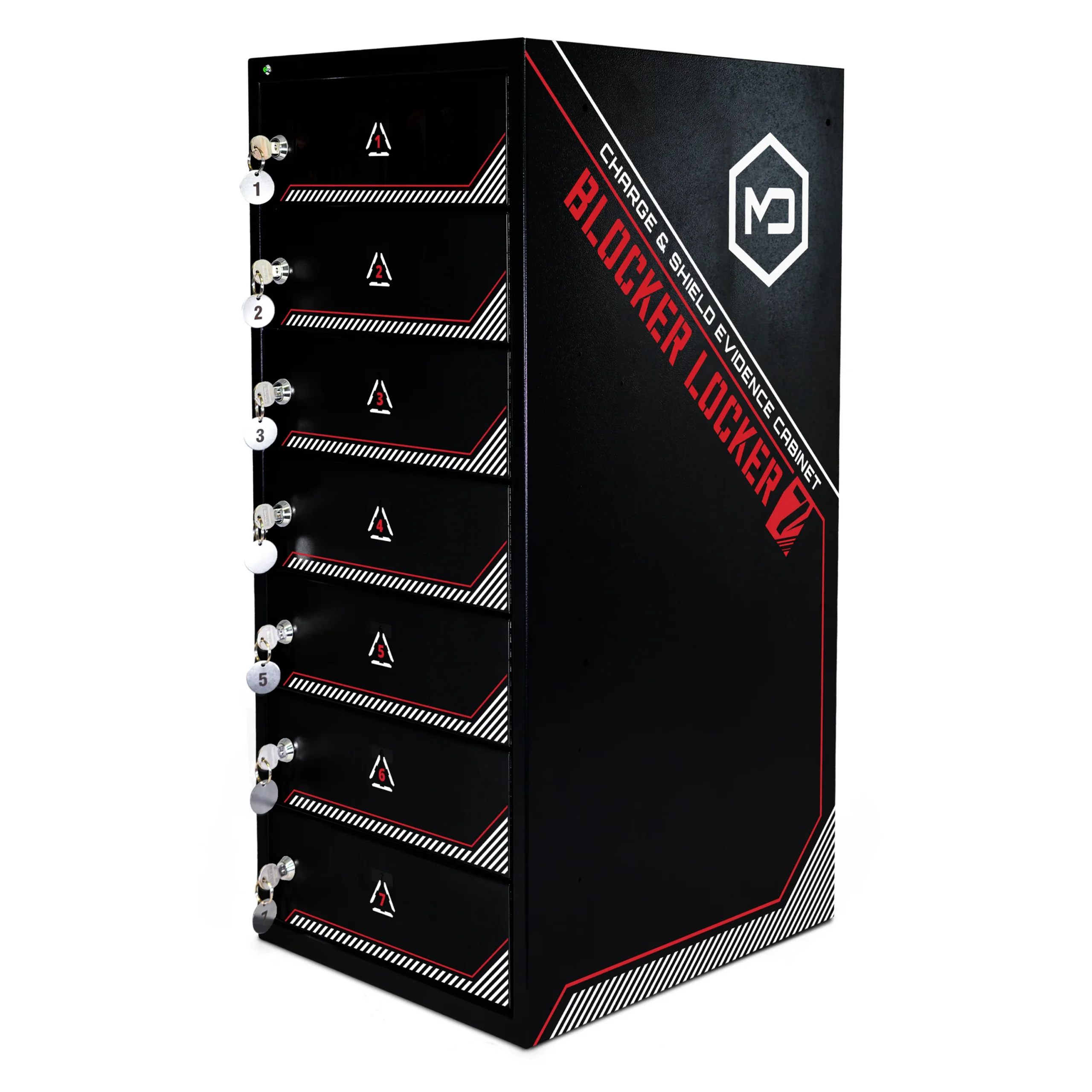
7 independently locked compartments, 2 devices each. Every compartment has its own numbered key, with 4 master keys for supervisor access and a key drop slot built into the cabinet.
Each bay carries power and 2 USB receptacles, so devices charge continuously while sealed. 7 Charge & Shield Faraday bags are included, using 2 layers of TitanRF fabric with dual paired seams. A MySpool power monitor sends an SMS and email the moment power is lost.
- Capacity
- 14 devices
- Compartments
- 7, individually keyed
- Dimensions
- 38 × 46 × 86 cm
- Weight
- 38.6 kg
Blocker Locker 7 Pass Thru
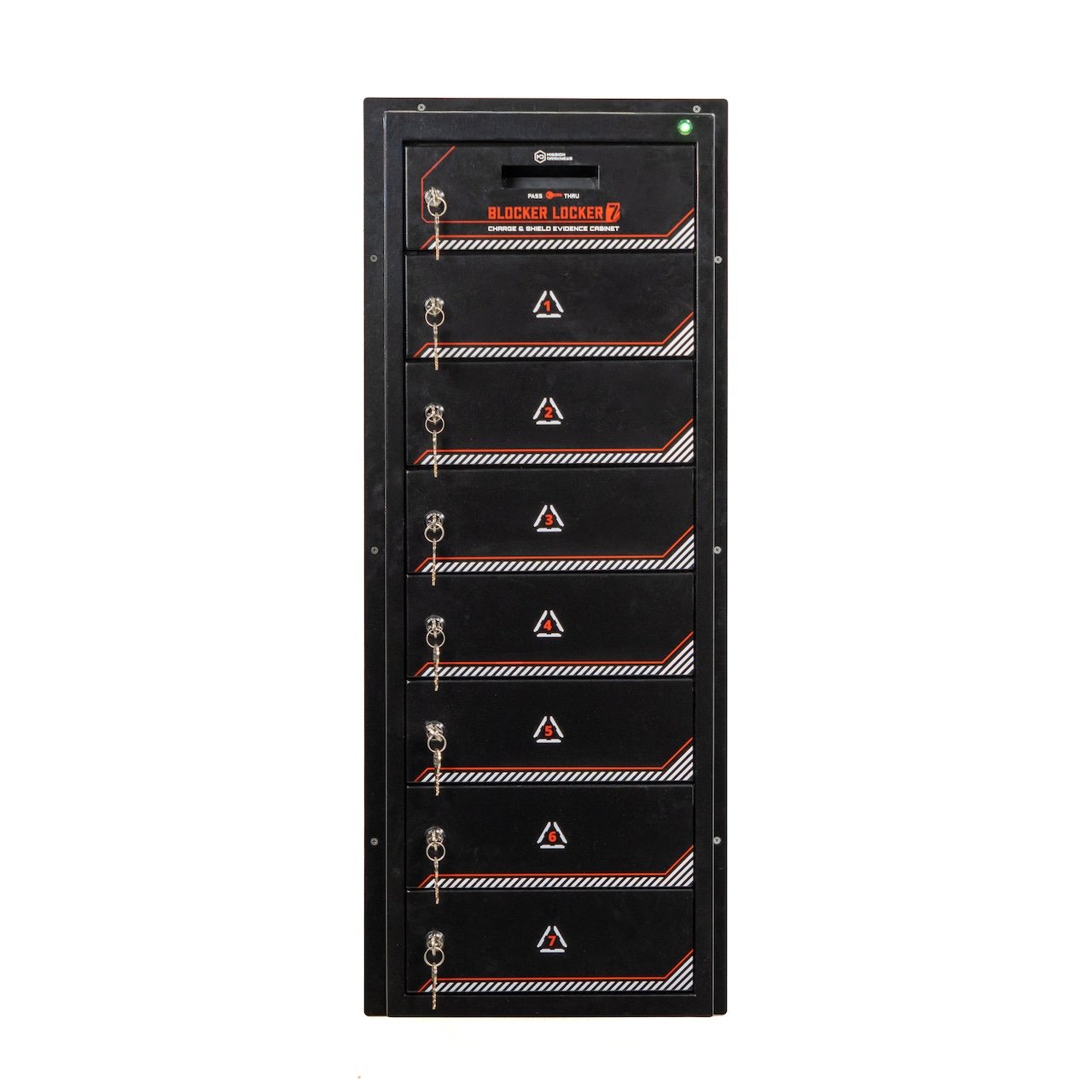
The same 7 compartments and 14 device capacity, built into a wall with a door on each side. Devices are deposited from one room and retrieved from the other, so intake staff and examiners never share an access point.
Hardwired to building power by an electrician rather than run from a cord. The included Charge & Shield bags use the NeoLok magnetic closure, which seals in one motion and can be operated wearing conductive gloves, with a transparent window for screen checks.
- Capacity
- 14 devices
- Access
- Dual door, pass through
- Dimensions
- 41 × 46 × 103 cm
- Power
- Hardwired, no cord
Forensic Crack Cabinet
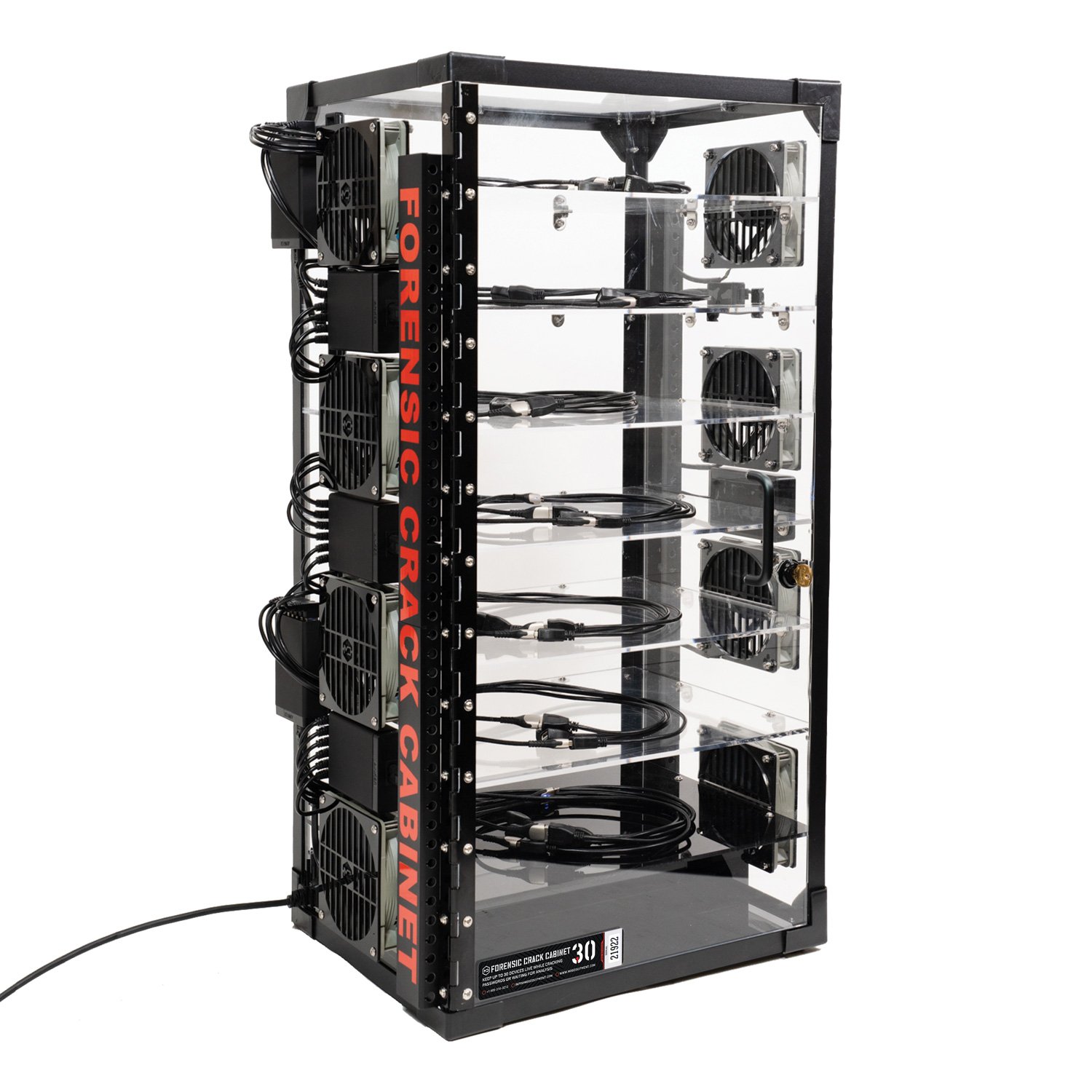
18 devices across 8 compartments, or 30 in the larger configuration. 5 mm transparent acrylic walls and shelves mean an examiner can read every screen without opening anything.
A master power switch cycles all devices at once, illuminating every screen so a cracked passcode is spotted in a single pass rather than device by device. 8 Noctua fans on a dedicated controller hold temperature down through long runs. Each compartment has room for the device and its paperwork side by side.
- Capacity
- 18 or 30 devices
- Cooling
- 8 fan Noctua system
- Dimensions
- 41 × 32 × 80 cm
- Tracking
- Uniquely serialised
Charge Chamber
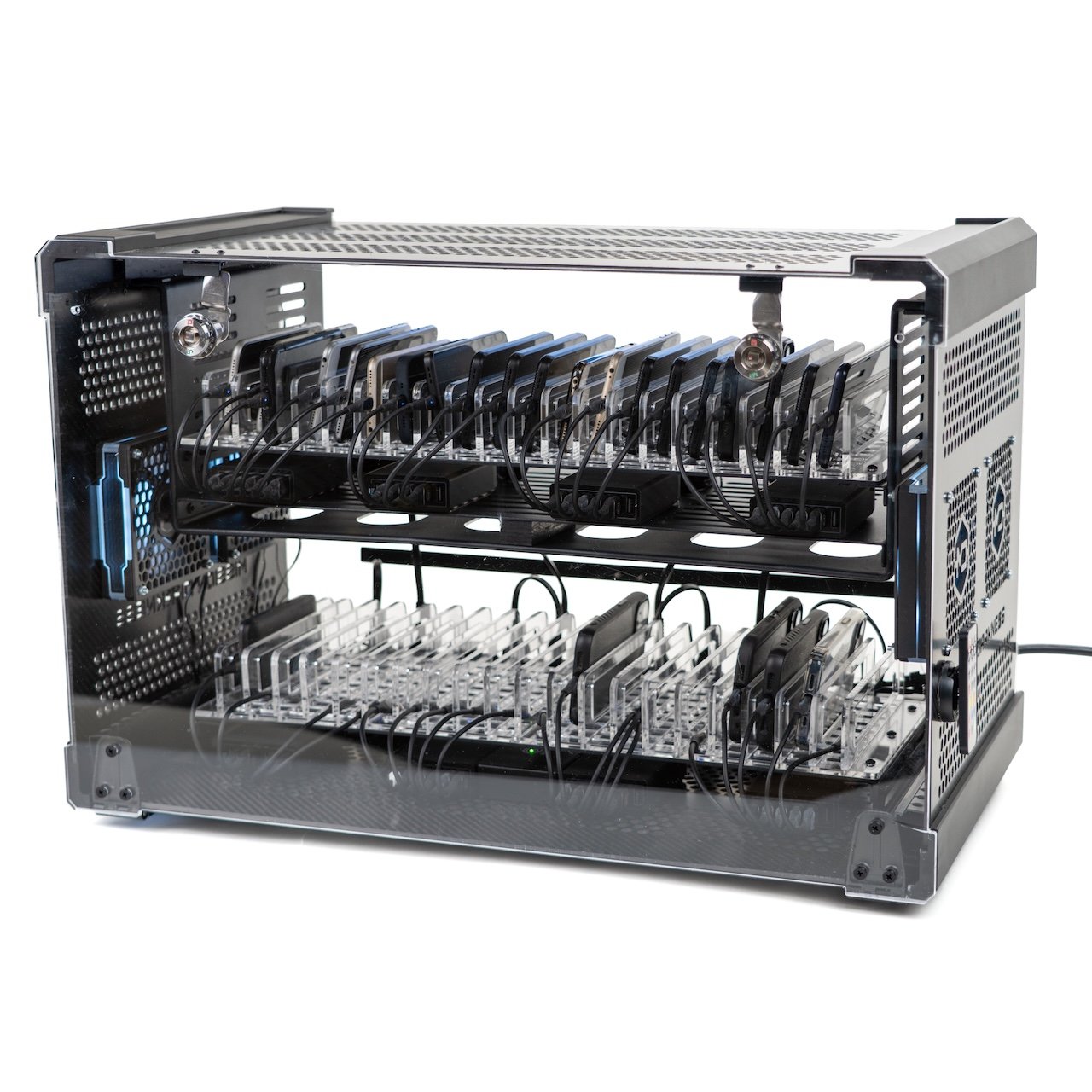
40 smartphones and 4 tablets per unit, stacking 3 high for 120 phones in the same floor area. Carbon fibre and machined aluminium frame with acrylic front and back.
Telemetry is what sets this one apart from the rest of the range. Built in cellular monitoring pairs with the Mission Darkness app and sends an SMS and email within seconds of any unit losing power, so a failure is known immediately rather than at the next physical check.
- Capacity
- 40 phones, 4 tablets
- Stackable
- 3 units, 120 phones
- Monitoring
- Cellular telemetry
- Tracking
- Uniquely serialised
Choosing between them.
The table below compares the main specifications of the four Mission Darkness cabinets.
| Cabinet | Capacity | Cooling | Locked bays | Alerting | Best for |
|---|---|---|---|---|---|
| Blocker Locker 7 | 14 devices | None | 7, keyed | Power loss, SMS and email | Intake where individual accountability matters |
| Blocker Locker 7 Pass Thru | 14 devices | None | 7, keyed | Power loss, SMS and email | Separating intake staff from examiners |
| Forensic Crack Cabinet | 18 or 30 | 8 fan system | Cabinet door | Power loss, plus visual check | Cracking runs where screens are monitored |
| Charge Chamber | 40 phones + 4 tablets, up to 3 stacks 132 | Dual fan | Cabinet door | Cellular telemetry and app | Backlog volume and unattended running |
Stacking the Charge Chamber
Each standalone unit holds 40 smartphones and 4 tablets. Up to 3 stacks vertically, with the same floor footprint.
40 phones, 4 tablets
80 phones, 8 tablets
120 phones, 12 tablets
Floor area remains unchanged at 66 × 37 cm, roughly a quarter of a square metre, for all three configurations. Three units is the manufacturer's rated stacking limit.
The costs versus the savings.
Few laboratories look at how streamlining their storage and charging infrastructure, using specialised purpose-built equipment that keep devices continuously powered, can bring significant savings in terms of staff time and preserving digital evidence.
Instead of one device at a time. A master power switch cycles every device simulataneously and illuminates every screen, so an examiner sees what has cracked in a single sweep. Significant time is saved when a full cabinet is checked several times a day.
Power failure alert. Telemetry sends SMS and emails the moment a unit loses power. The alternative is discovering the failure at the next physical check, at which point devices may have been dead for hours and the entire run is lost.
For devices that go dead. A device that shuts down mid attack can enter lockout or wipe. Restarting a crack that has already run for weeks is the single most expensive event that occurs in laboratories, and is entirely preventable.
Expected service life. The cabinets are invaluable laboratory assets, and the benefits derived are calculated by taking into account the number of devices expected to be processed across the estimated useful life of the cabinet of 8+ years.
As an example, to calculate the cost of using an $8,000 charge chamber that holds 44 devices over 8 years: $8,000 / 44 devices / 8 years /365 days = .06 cents per day per device. Power, cool, and monitor hundreds of devices for around $1.89 per month per device.
Compare this to the time cost of staff individually monitoring these hundreds of devices over many years. The risks of losing a device due to power failure. The overall implications to the case when data is lost.

The same power failure, monitored versus unmonitored
Scenario: a cabinet loses power overnight, weeks into a brute force run. The building is un-manned.
The unit's power cuts out. SMS and email alerts fire automatically to every nominated recipient.
The alert is received, indicating which unit has failed at which site. No-one wastes time figuring out where the problem is.
Power restored well before device batteries drain.
The unit's power cuts out. Nothing reports the event and nobody is around to notice.
Device batteries drain. Devices shut down one after another.
Devices found dead the following morning, with no record of when it happened.
By keeping devices on and protected, we have had better success getting into the majority of devices we process very quickly.
Cpl. Jason Shutters, Computer Forensic Analyst, Fort Collins Police Services
Measured by an accredited laboratory.
The Faraday bags supplied with the Blocker Locker range use TitanRF™ fabric, tested by Keystone Compliance in the USA, an accredited third party laboratory.
Testing is against two standards: (1) MIL-STD-188-125 for high altitude electromagnetic pulse thresholds, and (2) IEEE 299-2006 for shielding effectiveness. Average attenuation exceeds 90 decibels from low megahertz through to 40 gigahertz, covering cellular, Wi-Fi, Bluetooth, GPS, RFID and NFC.
Faraday bags that are tested by an accredited laboratory to meet these standards is essential in the law enforcement and digital forensics space, particularly when digital evidence presented to courts needs to survive cross examination. All of the Mission Darkness Faraday bags and enclosures meet or exceed these standards.
Compatible with the tools your lab already runs.
Sustained high load charging supports the major mobile forensic platforms through unlocking and extraction, including GrayKey, Cellebrite, Magnet, XRY, BlackBag and Oxygen.
The cabinet holds the devices powered, cooled and isolated. Your extraction and analysis workflow carries on unchanged.
The Charge Chamber also deploys inside a CYPHERCYLENT Faraday tent where a fully RF isolated working space is required, so devices can be power cycled without breaking signal isolation.
Common questions from procurement teams.
Contact us for anything not covered below.
Origin of Equipment
Mission Darkness designs and assembles in the United States and supplies law enforcement, military and government agencies in more than 85 countries. The TitanRF™ Faraday fabric is verified by an independent test laboratory in the US, and the crack cabinet range has been in law enforcement service since 2022.
Components
Charging cables are CE certified. Internal power hubs carry UL and CE certification. The power and charging path uses off-the-shelf, name-brand hardware in the Anker class. Tried, tested, and known. No unbranded power bricks, no mystery USB hubs, no parts you have to take a chance on.
Warranty
12 months manufacturer's warranty against defects in materials and workmanship from date of delivery. Multi year extended coverage available, aligned with the 8+ year service life, quoted on request.
Lead time
Lead times vary by cabinet and configuration, and units ship on a pallet from the United States direct to your site. We confirm lead times at the time of quoting.
Asset management
Every unit carries a unique serial number, which supports asset registers and chain of custody records.
Orders
Quotes, orders and invoices are in New Zealand dollars. Custodi handles international freight, customs and delivery, and we remain your single point of contact for support thereafter.
Work out which cabinet fits your workflow.
Capacity, access control and monitoring differ across the four options. Contact us to discuss your workflow and which solution best fits your requirements.
Talk to our team →